

The states partners see
The public API uses three human-facing labels:
These are the only three values the create endpoint accepts. Sending
anything else gets a clean
422 invalid_status with the allowed values
echoed in the error body.
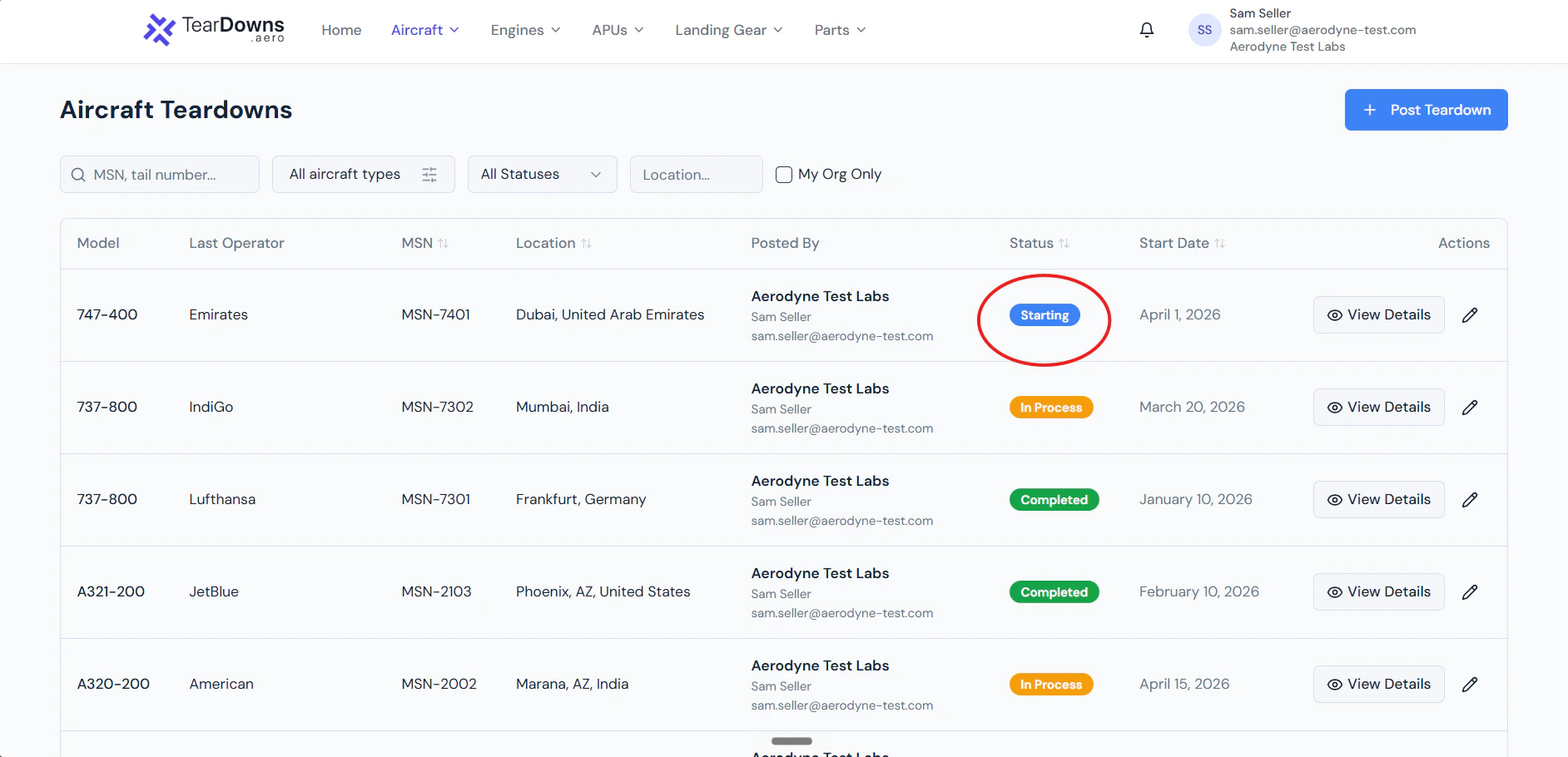
The badge in the teardown detail header. Same label whether the teardown was created by API or by the web wizard.
Why three lifecycle states and not draft/active/etc.? The public API
doesn’t expose a “draft” or “pending review” path every teardown
posted via API goes straight to active. Drafts are a UI-wizard
convenience, not a partner-API concept.
Setting the initial state from the API
Thestatus field on the create body picks the initial active state:
Moving between states
Use the transition endpoint:
Trying an action that isn’t valid from the current state returns
400 "Cannot perform 'X' from status 'Y'".
See the transition endpoint reference
for full action / param documentation.
Audit trail
Every transition writes anaudit_logs row with:
action=teardown.<action>(e.g.,teardown.complete).previous_state={ "status": "active_starting" }new_state={ "status": "active_in_process" }metadata.via_api = true,metadata.api_key_id,metadata.api_key_prefix.